What makes Jev different from a Chat LLM?
Key Takeaways
- Trained for structured decisions. Jev is trained to return typed answers and calibrated probabilities that software can use directly.
- Designed for parallel execution and speed. Its decision-focused design and parallel sampler avoid generating a text answer token by token. Independent questions can run together against shared context; actual speed gains depend on the workload.
- The current tradeoff: limited context and a narrower job. Jev 1.13 supports 64k tokens per request, with a 32k limit for the state plus the longest question. It is better suited to focused, less complex judgments than multi-step reasoning or large, distracting inputs.
Structured decisions ↗ · Design and speed ↗ · Context limits ↗ · Known limitations ↗
A probability should mean something.
- Training goal: TypeSafe describes RLCD—Reinforcement Learning for Calibrated Decisions—as post-training on pretrained language-model foundations.
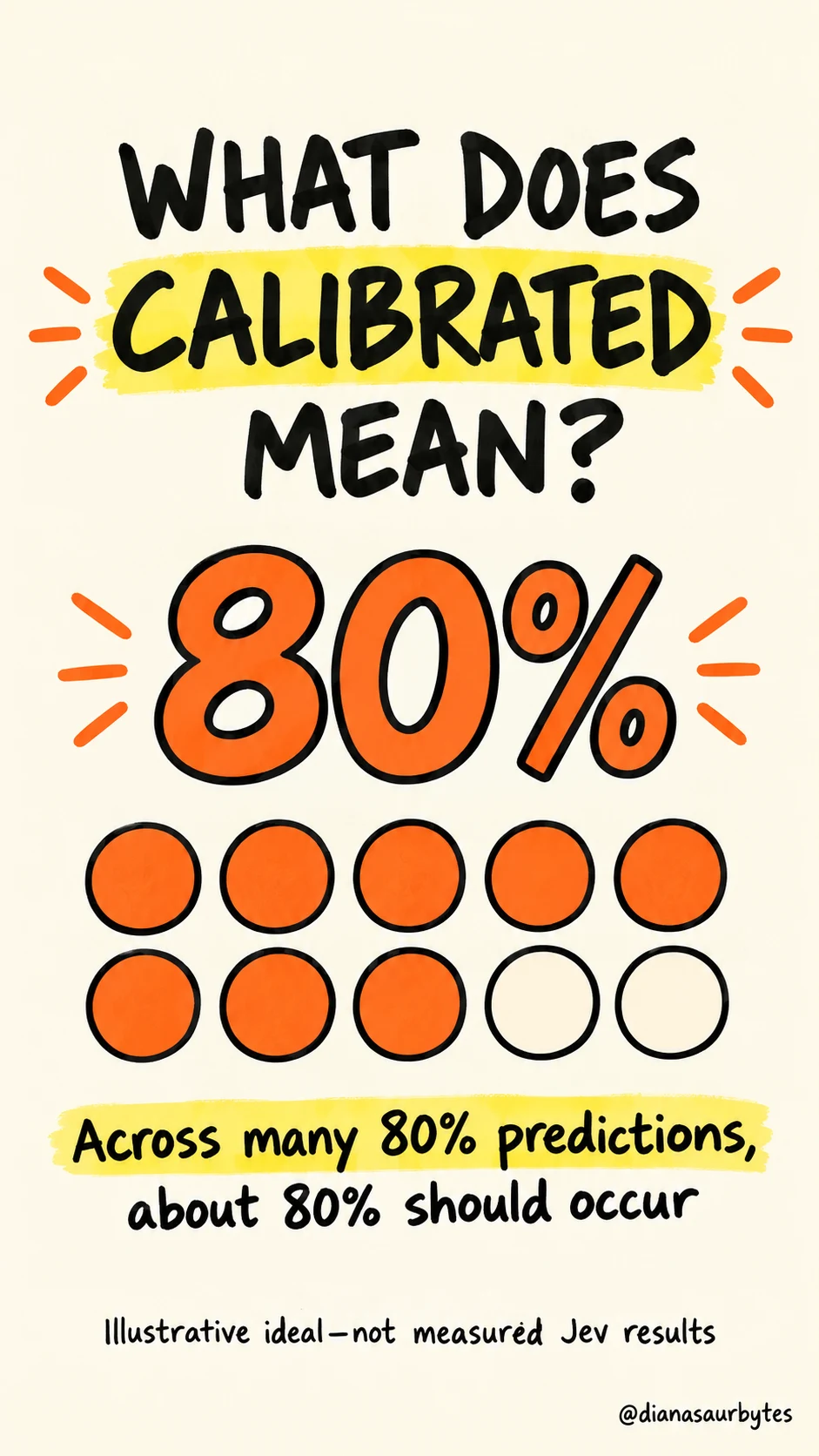
- Calibration: among many predictions assigned roughly 80% probability, the event should occur roughly 80% of the time.
- Not a correctness certificate: an individual high-probability answer can still be wrong. Calibration is a property you assess across labeled examples.
- Product implication: use uncertainty to decide when to automate, gather more evidence, or fall back. Validate the probabilities on your own workload.
Ask independent questions. Compose in code.
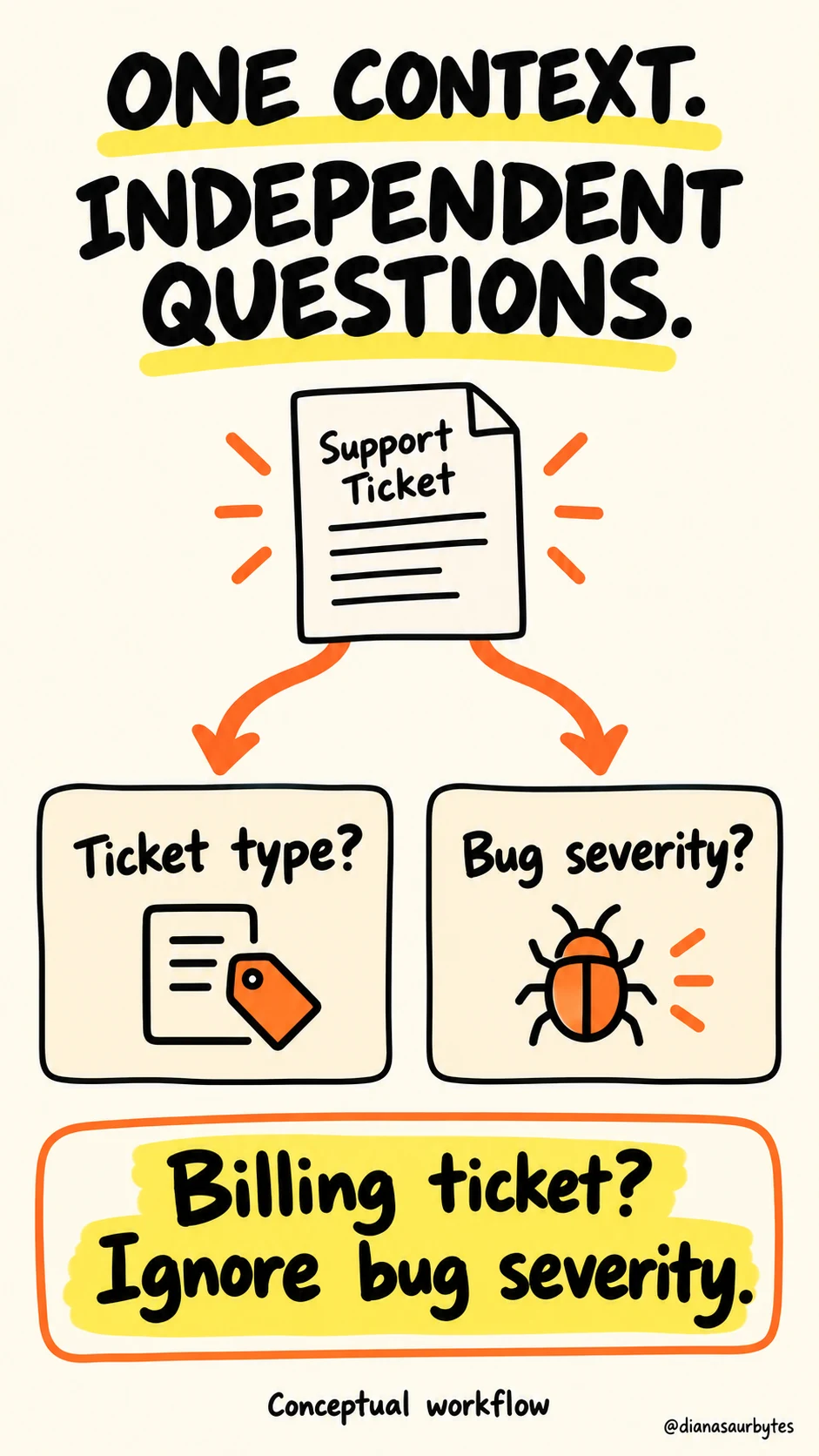
- One shared state: provide the evidence each question needs, such as a message and relevant records.
- Independent questions: several judgments can run in parallel against that state. One cannot use another’s answer within the same call.
- Dependencies belong between calls: if a question needs a previous answer or newly fetched evidence, make that a later step.
- Architecture claim: TypeSafe describes a parallel sampler that produces decision outputs without generating text. Its full internals are not public.
Give the model a bounded job.
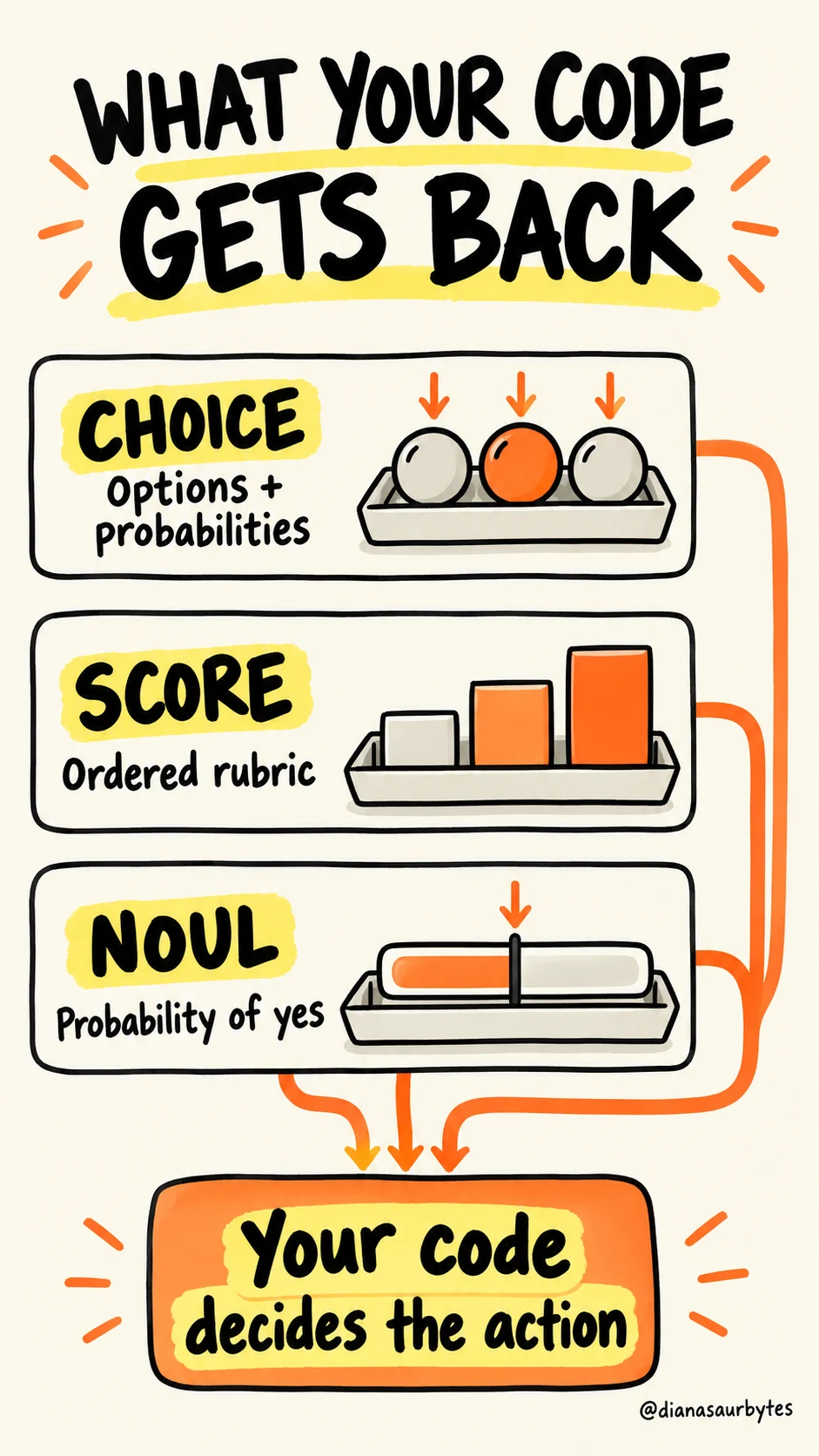
- Choice → a category: select an option and return probabilities across the options.
- Score → an ordered judgment: evaluate against defined levels and return a score and distribution.
- Noul → probability of yes: answer a focused yes/no question with a value from zero to one.
- Confidence is a separate concept: Choice and Score return a confidence value derived from the distribution; Noul does not have a separate confidence field.
- Code owns the action: a model can identify a refund request. Your application still checks transactions, permissions, and refund rules before doing anything.
Consistency ≠ determinism.
- Determinism: with exactly the same input and execution conditions, you get exactly the same output. Identical labels alone do not establish identical probability outputs.
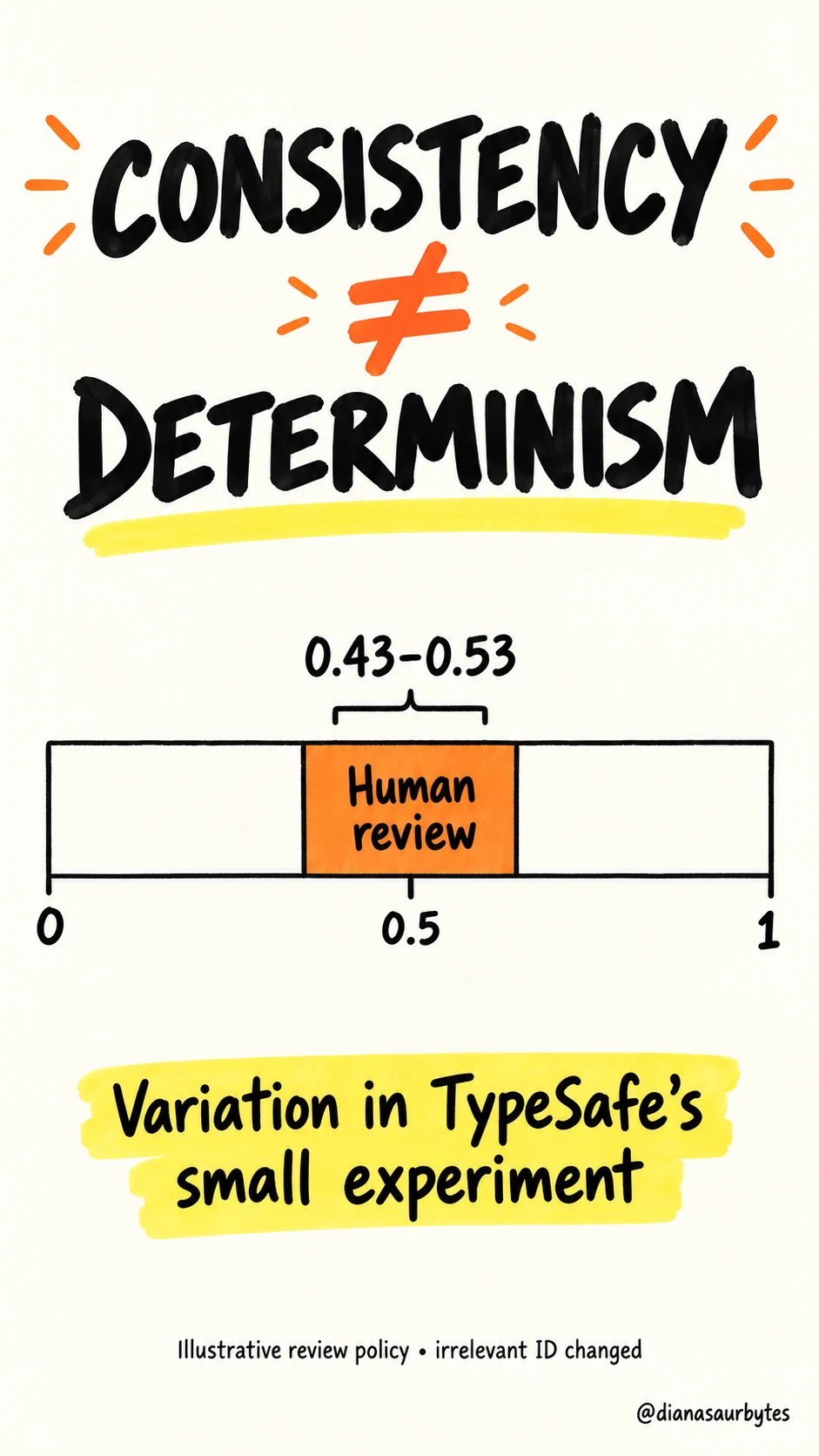
- Consistency: outputs remain similar across repeated evaluations or irrelevant input changes.
- Accuracy: is the answer correct? A system can be consistently wrong—even perfectly deterministic and wrong.
- Calibration: do probabilities match observed frequencies across many labeled cases? Stable probabilities are not automatically well calibrated.
What the Jev evidence actually shows
- TypeSafe’s cookbook tested one claim, 14 questions, and 15 repeats per condition. Jev showed less average probability variation than the tested LLM probability configurations in that setup.
- One Jev answer ranged from 0.43 to 0.53, crossing a 0.5 cutoff.
Measure the decision and the resulting action.
- Correctness: compare against labeled cases, especially ambiguous inputs and costly mistakes.
- Repeatability: repeat identical requests, then separately vary irrelevant details. Track probability spread, label flips, and action flips.
- Workflow performance: compare accuracy, total cost, latency, and fallback frequency with your existing call.